Designing In the Gray
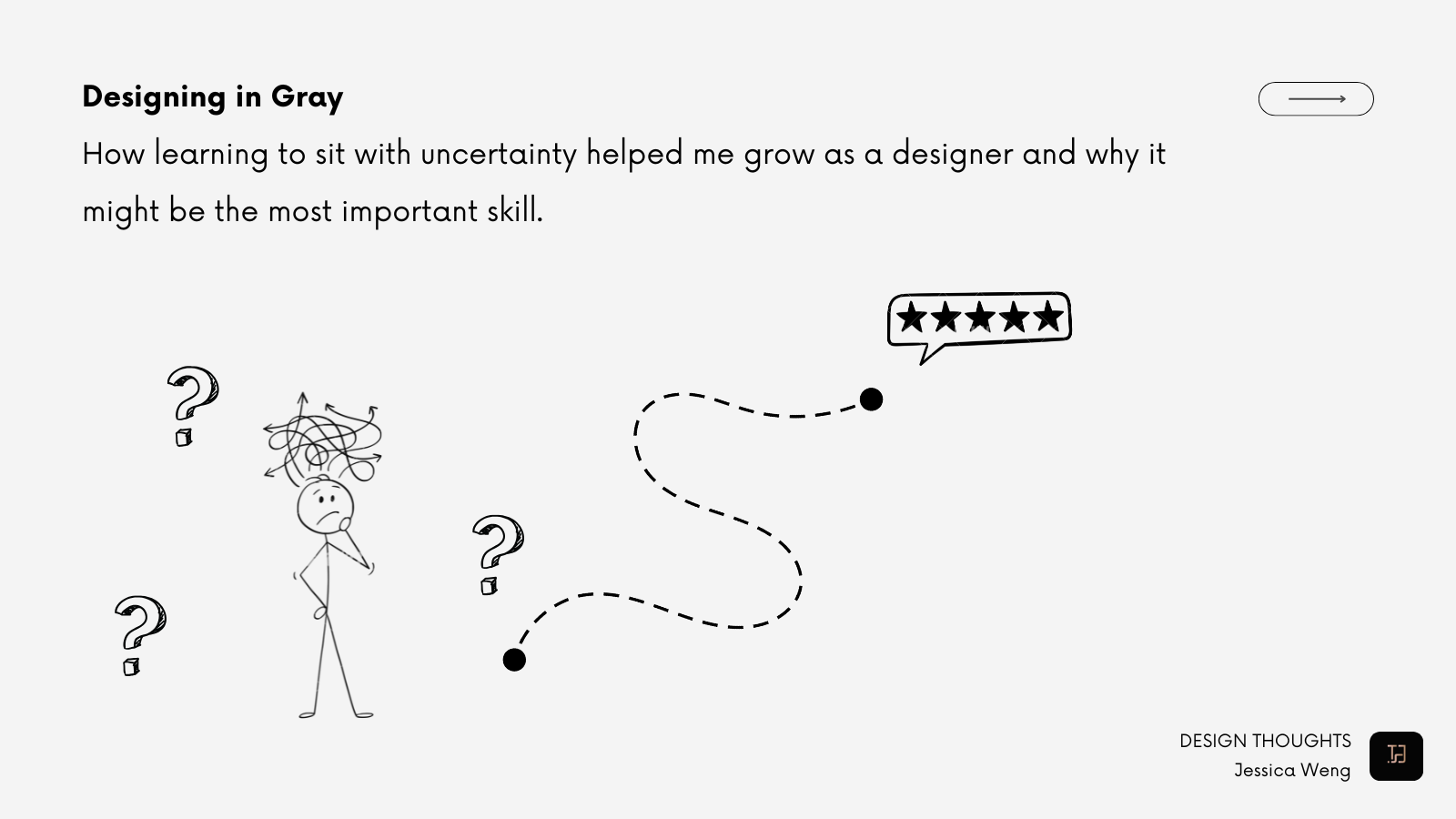
As AI continues to evolve and the UX job market grows increasingly competitive, I find myself thinking more about what makes a designer truly stand out.
I still care about craft. I spend time refining prototypes, and I know a strong portfolio matters. But the farther I've gone in my career, the more I've realized: polished work isn't always what carries you through.
Projects get messy. Roles blur. Expectations shift. And in those moments, what's helped me move forward hasn't been certainty — it's been the ability to navigate ambiguity.
Early on, I remember debating whether I should be a product designer or a UX designer. What did it even mean to choose between the two? At the time, the roles felt blurry and interchangeable.
But as I gained experience, I realized that clarity in titles was less important than learning how to move forward in the gray.
Learning to Think Like a Product Owner
In large teams, vision often trickles down from leadership with either annual roadmaps, or quarterly goals. But in smaller organizations and agency settings, I noticed something different: there was often no clear roadmap. And so, I began to think beyond my role.
I had to learn to listen for vision in conversations. I started asking bigger questions about business visions. And then, I'd translate those insights into actionable design. This came from sitting with uncertainty, from listening more closely and from trusting that I brought valuable insights. The mindset has shifted from just a designer into a strategic partner.
Design for Better Experience
Over time, I've come to appreciate how UX design lives at the intersection of business goals and human needs.
There were moments when I found myself caught between the two — wondering what was truly valuable, what counted as "innovation," and who I was really designing for. Especially in B2B projects, the term "user" can feel distant. But real people sit on the other side of our systems — staff, customers — each with needs, habits, and pressures of their own.
In one recent project — designing e-commerce flows for a CRM used in gyms — I started asking different questions:
- How can we make staff onboarding feel less overwhelming?
- Can we streamline checkout so there's no friction when a customer is standing at the counter?
- How might we help staff get the right information quickly, so they can be more present with customers?
These weren't just design decisions. They were reflections of the empathy I'd built over time and the comfort I'd found in working through uncertainty.
You're Not Just Assigned. You Shape
If there's one truth I keep returning to, it's this: UX design isn't about being handed answers. It's about helping define the right questions.
It often starts with the simplest conversations:
- How do you manage inventory in your day-to-day?
- What's frustrating about your current checkout flow? Can you walk me through how it goes with a customer?
These questions are rarely part of a brief. They're what you ask when you're invested in understanding the real problems, not just the documented ones.
Also, when tackling requirements, the job for me isn't to execute without thinking. Sometimes that means pushing back. Sometimes it means asking again. And sometimes it means knowing when to pause, regroup, or reframe. It's not a linear process — it's iterative. It's design.
Ambiguity used to make me uncomfortable. Honestly, it still does sometimes. But now I recognize it as a signal — a sign that there's room for insight, vision, and impact.
Nothing is ever final. And maybe that's the point.
Finding Clarity in the Unclear
I didn't set out to get good at navigating ambiguity — I just kept running into it. Over time, I stopped resisting the gray and started learning how to work within it. I'm still learning. Still figuring out how to ask better questions, how to listen more deeply, and how to shape clarity where there wasn't any before.
It's not always comfortable. But it's where I've found the most growth and the most meaning — in my work. And maybe, that's the real work of being a designer.